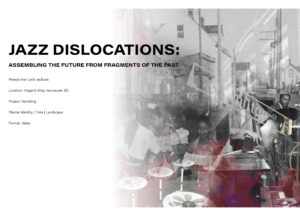
Jazz Dislocations: Assembling the Future from Fragments of the Past
Jazz Dislocations explores the mytho-history of “Hogan’s Alley,” a dislocated community of African-Canadians in Vancouver, BC. Disjointed fragments explore individual and collective identity within dislocated life and the nonlinear acts of leaving, arriving, mourning, and becoming. Jazz as a “secret Black technology,”1 serves as an improvised language of resilience, transcending time and begetting new constructed realities through the process of assemblage.
Hogan’s Alley was Vancouver’s first concentrated African-Canadian community. During the mid-20th century, it was comprised of a four-block long lane where train porters, who were predominantly Black men, disembarked from their travels at the end of the Canadian National Railway. The intermingling and settling of porters helped to transform Hogan’s Alley into a vibrant destination for food and jazz through the 1960s. When the city targeted Hogan’s Alley for freeway construction, the community was dislocated, leaving everlasting fragmentation of Vancouver’s Black community. The documented history of Hogan’s Alley is largely incomplete, but the presence of its absence has impending consequences for Black Canadians in British Columbia today and into the future.
Jazz music as one of the most remembered artifacts of life in Hogan’s Alley, speaks directly to how the history of this forgotten community transcends time and continues to construct futures. In “The Last Angel of History” (Akomfrah 1996), music is described as a “secret Black technology,” that explores the future and perpetuates the technological revolution. In Hogan’s Alley, jazz thrived not only as a language of resilience in form of community empowerment but as tool for understanding the adaptive capacity of cities and communities and assembling futures.
Jazz Dislocations explores the mytho-history of “Hogan’s Alley”. Disjointed fragments explore individual and collective identity within dislocated life and the nonlinear acts of leaving, arriving, mourning, and becoming. Jazz as a “secret Black technology,” serves as an improvised language of resilience, transcending time and begetting new constructed realities through the process of assemblage. Each vignette is constructed with fragments of voices, jazz music and soundscapes that speak to the history of Hogan’s Alley, and the cycles of dislocations experienced by their ancestors and descendants.
Akomfrah, John (1996). Last Angel of History. Black Audio Film Collective.