Mud / Digging the Duwamish is an exploration in critical cartography. It is a story about mud and
the constellation of characters who shape the river. After more than a century of industrial contamination, what kind of alchemy can turn the poison into medicine?
Mud calls into question the human and the modern notions of the river. Before we had a name for a river, and maps to describe its boundaries, we had flows of wetness. Mud/ Digging the Duwamish expands on Anuradha Mathur and Dilip da Cunha’s ideas about wetness. They ask whether we should consider water as wetness, since everything exists on this gradient.
Flows of mud, water, fire, and air made the Duwamish Valley and then people made ideas about rivers. James Rasmussen explains in a radio interview titled The Duwamish Isn’t Just a River to This Lifelong Steward – It’s Part of His Family that “there is no people without a river and no river without a people.” The Duwamish River is a social construction, an assemblage of human and more-than-human characters. In a constant state of reconfiguration, it continues to become. Eunice Blavascunas discusses the ontology of mud in In the mud and Of the Mud. She writes about mud and becoming, and its relationship with humans:
Mud is for becoming with; that mixture of clay and sand, which acts with humans to make homes and earthen ovens. Mud is everywhere. We are all in the mud (in the muck and the mess) and of the earth. The mud holds fragments of matter deposited by flows of things over time. In modern times, humans have radically altered these flows. Critical Zones: the science and politics of landing on earth (edited by Bruno Latour, Peter Weibel) describes Moderns as people who live off land they don’t occupy. Emerging from colonization and industrialization,
Moderns have become increasingly separated from territory. The separation is particularly evident along the Lower Duwamish, where industry occupies almost all of the land, and where mud is most poisoned. And yet moderns and industry are only a small part of the constellation of characters shaping mud.
Mud as a method and as a material to work with
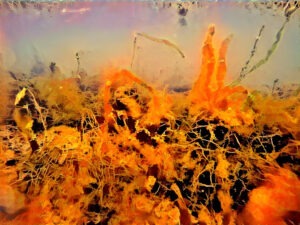
As a method, mud is messy. Digging the Duwamish was messy. My exploration revealed a messy assemblage of things I cannot fully comprehend. I was driven by the desire to understand what the river is made of, and it led me to mud. I searched for fragments – people, objects, moments that I could see or hear or feel – and I became acutely aware of all the dark matter, all the things I cannot know from within my human body. Blavascunas writes about mud as a method, explaining that “becoming worldly can speak to a radical attentiveness to what actually is.” As a material, mud in the Duwamish Valley is a mixed bag. Although it is poisoned, it is still alive. It is “the very material of creation” and rather than separate ourselves from it, we can work with it to understand its political agency. Mud can become a material that challenges the stratification between humans, and between humans and more-than-humans.
Conclusion – Intersections between design and environmental justice
Grace Dillon’s work embodies intersectionality and calls on the artist-scientist to advance different notions of futurity. Why Intersectionality in Fiction Matters expands by bringing many authors into conversation with one another. The Duwamish River Community Coalition is also pursuing an intersectional approach to clean the river.
DRCC recently changed their name to reflect a more holistic understanding of environmental justice, one which also encompasses economic justice, racial justice, and climate justice. The intersection of environmental justice, mud, and design could be explored much further.